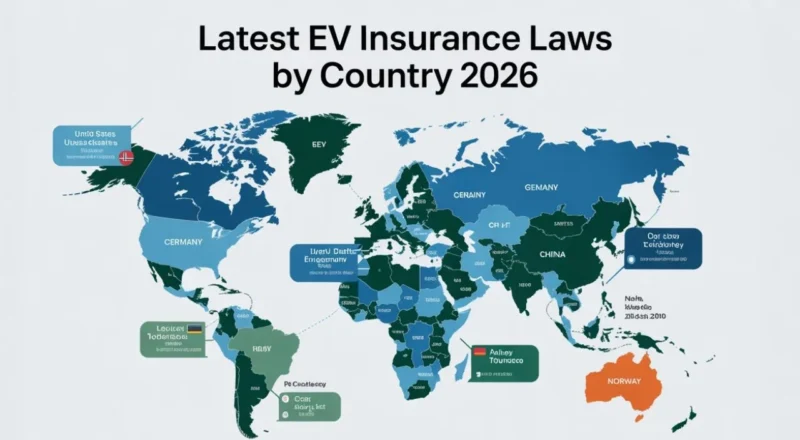
Latest EV Insurance Laws by Country 2026: The global electric vehicle (EV) revolution is accelerating rapidly, and with it comes a major transformation in insurance laws, coverage requirements, and regulatory frameworks. Governments worldwide are introducing new policies to address battery risks, advanced electronics, safety compliance, and rising repair costs. For consumers, fleet operators, and insurers, understanding the latest EV insurance laws by country in 2026 is essential for compliance and financial protection.
This comprehensive guide explains new EV insurance regulations in 2026, country-by-country, while offering practical advice to help drivers choose the right coverage. The article is designed for high-value SEO, Google Discover optimization, and AdSense compliance, providing actionable insights for EV owners globally.
Why EV Insurance Laws Are Changing in 2026
Electric vehicles differ significantly from traditional petrol or diesel cars. They rely heavily on high-voltage battery systems, software, and specialized components, which require new insurance frameworks.
- EV batteries alone can represent the most expensive component, making insurance essential.
- New policies are emerging to cover charging-related risks, software failures, and battery degradation.
- Governments are strengthening safety regulations to reduce fire incidents and financial risks.
Insurance providers are also redesigning policies to address battery performance failures, not just accident damage, reflecting the evolving risk profile of EVs.
In addition, battery replacement costs can reach thousands of dollars, encouraging specialized coverage options and mandatory add-ons in some markets.
Read Also: Big EV News: Honda-Sony Afeela Project Halted
European Union & United Kingdom: Mandatory Liability + Battery Coverage Trends
Across Europe and the UK, the legal baseline for EV insurance remains motor third-party liability coverage, which is mandatory for all vehicles, including electric cars.
However, 2026 trends show additional emphasis on EV-specific risks:
- Comprehensive coverage is strongly recommended due to high battery repair costs.
- Battery damage can cost between €15,000 and €25,000, influencing policy requirements.
- Many insurers now include charging cable and wallbox protection.
Regulators and insurers in Europe are also updating vehicle salvage classifications, especially for damaged high-voltage batteries. If structural battery damage occurs, some vehicles may be classified as non-repairable and scrapped, affecting claims and insurance valuation.
These changes reflect a growing regulatory focus on consumer safety and transparency in EV accident reporting.
United States: Expanding Regulatory Oversight and Risk Models
In the United States, EV insurance laws are evolving primarily through state-level regulatory frameworks. In 2026, regulators are prioritizing:
- Enhanced risk assessment for EV components
- New solvency rules for insurers covering advanced technology vehicles
- Closing coverage gaps for emerging mobility risks
Insurance regulators are working on robust frameworks to better assess risks and capital requirements, ensuring insurers remain financially stable as EV adoption increases.
Additionally, policy trends emphasize:
- Battery warranty integration
- Software-related liability coverage
- Charging infrastructure risk inclusion
These developments aim to ensure insurance systems remain sustainable as EV adoption accelerates nationwide.
India: 2026 Battery Safety Regulations Impact Insurance Policies
India introduced stricter EV battery safety rules in 2026, significantly affecting insurance requirements. These regulations include:
- Enhanced battery testing procedures
- Thermal runaway protection requirements
- Waterproofing and short-circuit safety validation
- Manufacturer accountability standards
These safety rules are expected to influence insurance pricing, policy conditions, and claim assessments, especially for fire-related incidents.
Motor insurance in India now increasingly covers battery systems, electric motors, and advanced electronics, reflecting the specialized nature of EVs.
Additionally, insurers in India are exploring performance-linked battery insurance, where claims may be triggered if battery efficiency declines within warranty limits.
These changes highlight India’s move toward more comprehensive EV-specific insurance frameworks.
China: Strict Battery Standards Influencing Insurance
China is introducing some of the world’s strictest EV battery safety standards, effective July 2026.
These rules focus on:
- Thermal safety requirements
- Fire resistance
- Structural battery integrity
- Mandatory certification
Insurance providers must adapt to these stricter standards, as compliance affects premium calculations and claim eligibility. Vehicles meeting higher safety benchmarks may qualify for lower premiums and extended coverage options.
China’s regulatory approach emphasizes preventive risk reduction, reducing insurance claims related to battery fires.
Philippines & Southeast Asia: Expanded Coverage Requirements
In Southeast Asia, EV insurance is evolving to include charging-related risks and battery replacement coverage. Most comprehensive policies now cover:
- Electrical damage
- Flood-related battery failures
- Charging incidents
- Home charger protection
This shift reflects climate risks and growing EV adoption in the region. Insurers also assess:
- Charging habits
- Battery health
- Software systems
These factors influence premium pricing and policy approval.
Global Trends in EV Insurance Laws for 2026
Across countries, several universal changes are emerging:
1. Battery-Specific Coverage Becoming Standard
Traditional car insurance focused mainly on accidents. EV policies now include:
- Battery replacement coverage
- Thermal damage protection
- Performance degradation coverage
These specialized add-ons address the most expensive EV component.
2. Charging Infrastructure Coverage
Insurance policies increasingly cover:
- Home wallboxes
- Charging cables
- Public charging damage
This reflects the expanding charging ecosystem.
3. Software & Cyber Risk Protection
Modern EVs rely on software updates and connectivity. Insurers are beginning to offer:
- Cyberattack coverage
- Software malfunction liability
- OTA update failure protection
4. Mandatory Safety Compliance for Insurance Eligibility
Countries like China and India require certified battery safety compliance, affecting insurance approval and premiums.
5. Higher Premiums but Better Protection
EV repair costs are often higher due to specialized components, which can increase insurance premiums, but also lead to broader coverage options.
How These Laws Affect EV Owners
EV drivers must consider:
- Battery protection add-ons
- Charging equipment coverage
- Higher repair costs
- Comprehensive policy requirements
Experts recommend fully comprehensive insurance, especially for new EV buyers, because third-party coverage alone does not protect the vehicle or battery.
Tips for Choosing EV Insurance in 2026
To comply with global EV insurance laws:
- Always select comprehensive coverage
- Add battery protection riders
- Include charger and cable coverage
- Check software liability coverage
- Verify compliance with national safety regulations
These steps ensure legal compliance and financial protection.
Read Also: Volvo EX90: The Future of Electric Luxury SUVs Set to Launch in India by September 2026
Future Outlook: What to Expect Beyond 2026
The next wave of EV insurance regulations may include:
- Mandatory battery insurance
- Autonomous driving liability frameworks
- Real-time telematics pricing
- Subscription-based insurance models
As EV adoption grows, insurance laws will continue evolving rapidly.
Conclusion
The latest EV insurance laws by country in 2026 reflect a global shift toward specialized protection for electric vehicles. Governments and insurers are adapting to new risks involving batteries, software, and charging infrastructure.
Key takeaways:
- Third-party insurance remains mandatory in most countries
- Battery-specific coverage is becoming essential
- Safety regulations are influencing premiums
- Comprehensive policies are strongly recommended
Understanding these changes helps EV owners stay compliant, reduce financial risk, and choose smarter insurance coverage.
This evolving landscape makes EV insurance not just a legal requirement but a critical component of electric mobility in 2026 and beyond.
[…] Read Also: Latest EV Insurance Laws by Country 2026: New Rules Every Electric Vehicle Owner Must Know […]
Добрый день! Хочу рассказать своим опытом покупки недорогих билетов. Недавно хотел путешествие из Москвы и долго просматривал предложения на разных сайтов. Различие в стоимости составил ощутимым — на одинаковый рейс тарифы отличались в разы. Захотелось использовать хороший агрегатор.
В результате открыл для себя прямые рейсы из праги — и на нём были максимально доступные цены. Отдельно отмечу — сравнивает варианты сразу от разных перевозчиков, даже недорогие авиалинии такие как Pegasus и Wizz Air. Результат — экономия примерно 30 процентов — советую попробовать!
Народ, собрался затронуть тему про бронирование бюджетных билетов на самолёт. Сам по себе мотаюсь по миру раз в пару месяцев — больше по европейским странам, порой в Тбилиси или обратно. Раньше смотрел на куче агрегаторов, но затем перешёл на аэропорт в англии и осознал что этот ресурс серьёзно лучше. Основной плюс — показывает низкобюджетные рейсы, каких привычные сайты часто не находят. К примеру, в феврале купил билет из Стамбула в Милан за смешные деньги — был в шоке от цены.
I’ve recently been exploring different color palettes like deep summer and soft winter to pinpoint the best colors for my pale olive skin. Understanding your skin tone, whether you have a red undertone or yellow undertone skin, can greatly impact your fashion choices. If you’re thinking about what is my color palette or want to try a free color analysis online, tools like the 16 season color analysis test and subsequent analyses like deep summer color analysis or soft winter color analysis can be incredibly helpful.
For those using the Color Analysis Pro app and wondering how to cancel color analysis pro subscription, you can review detailed instructions here deep summer color season . Whether you’re trying to decide between deep summer palette or soft winter palette options, keeping a skin tone chart available can support you in picking the optimal colors for fair olive skin or pale olive skin tone. Also, if you have fair olive skin or are seeking for best clothing colors for Asian skin tone female, these palettes and apps can be a fantastic starting point.
Эта познавательная публикация погружает вас в море интересного контента, который быстро захватит ваше внимание. Мы рассмотрим важные аспекты темы и предоставим вам уникальныеInsights и полезные сведения для дальнейшего изучения.
Исследовать вопрос подробнее – https://vivod-iz-zapoya-2.ru/
Привет! Тут решил поделиться — вдруг кому пригодится. Мы с мужем уже давно хотели слетать во Флоренцию, и наконец-то в сентябре наконец поехали. Цель была не простая: уложиться в один день во Флоренции, так как потом отправлялись дальше по маршруту, и времени оставалось буквально в обрез. Читала массу источников с маршрутами, и почти все предлагали какие-то списки без практическое тайминг.
Потом нашла на хороший сайт — там был пешеходный маршрут по Флоренции именно с картой и таймингом. Подкупило то, что автор честно указывал: что можно посетить, а куда лучше оставить на другой раз. Плюс там увидела толковую статью про аутлеты рядом с Флоренцией — честно понятия не имела, что в часе езды есть известный аутлет-центр! флоренция достопримечательности за 1 день
Флорентийский день получился буквально здорово. Получилось дойти до Собора Санта-Мария-дель-Фьоре, пообедать в симпатичной траттории — кстати, про дешёвую еду во Флоренции на сайте тоже написано свой материал! Весь этот маршрут — без такси, не тратя никаких гидов.
Кто тоже собирается съездить во Флоренцию — прям советую заранее подготовиться туда до отъезда. Правда экономит много нервов при планировании.
Люди, ну вот наконец написал про поездку в Германию! Так много всего надо рассказать, начну с главного.
Для начала посмотрел Потсдам — это реально красивый. Маршрут по Потсдаму — очень выполнимо, если грамотно планировать. Голландский квартал — просто кайф: краснокирпичные домики словно из другого мира. Все главные места Потсдама обошёл в один день — дворцовые парки там шикарные.
фантазия ленд кельн
Потом немецкая дорога сказок — если не слышали: это тематический маршрут через несколько городков включая Шонгау и Донаувёрта. Замок Браунфельс и замок Вальдек обязательно включить в маршрут. Понравились немецкие музеи — бесплатные дни бывают часто. Всю эту информацию собрал с этого ресурса — подборки там дельные.
[…] Read Also: Latest EV Insurance Laws by Country 2026: New Rules Every Electric Vehicle Owner Must Know […]