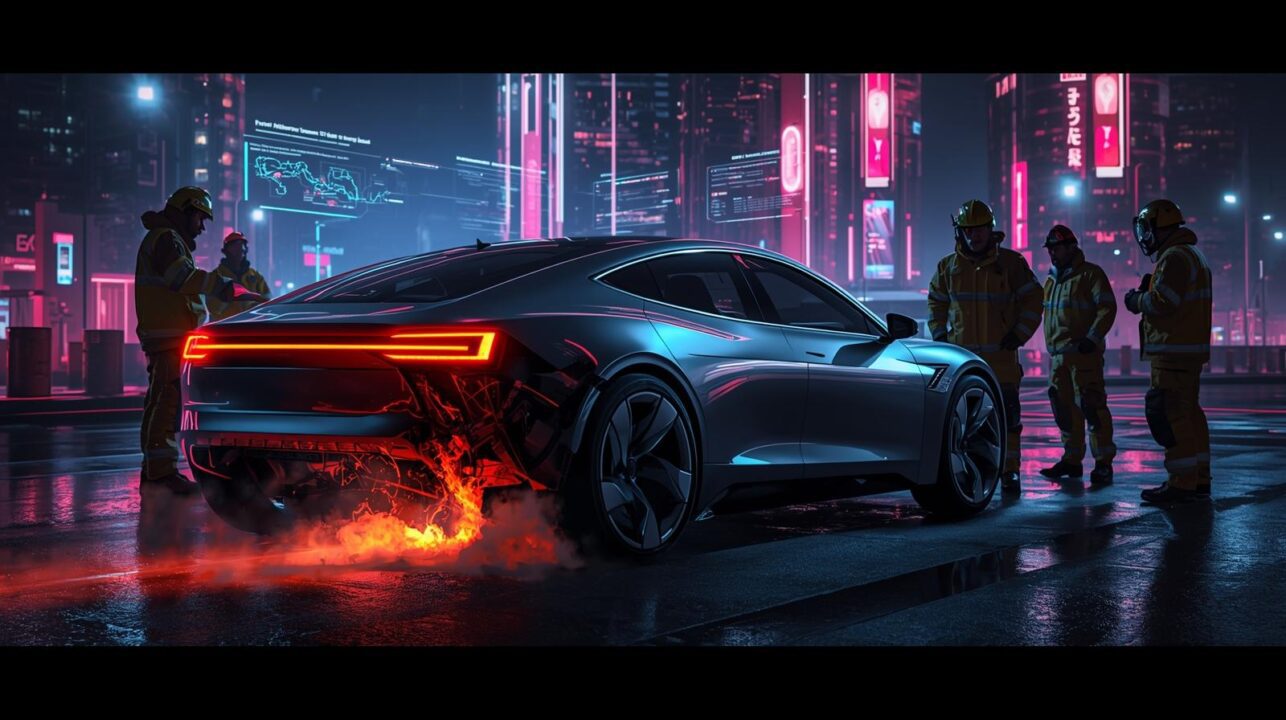
EV battery fires and insurance: Electric Vehicles (EVs) are rapidly transforming global mobility, offering cleaner transportation, lower running costs, and reduced dependence on fossil fuels. However, as EV adoption accelerates, EV battery fires have become one of the most discussed and misunderstood risks associated with electric mobility. While such incidents remain statistically rare, their complexity, intensity, and high repair costs have significantly impacted EV insurance policies worldwide.
For EV owners, understanding the connection between battery fires and insurance coverage is no longer optional. It directly affects premiums, claim approvals, vehicle safety, and long-term ownership costs. This in-depth article explains why EV battery fires occur, how insurers assess the risk, what is covered or excluded in insurance policies, and how owners can protect themselves financially and physically.
Understanding EV Batteries and Fire Risks
Most modern EVs use lithium-ion battery packs. These batteries are energy-dense, efficient, and long-lasting—but they also store massive amounts of energy in a compact space. When something goes wrong, the consequences can be severe.
What Makes Lithium-Ion Batteries Vulnerable?
- High energy density
- Sensitive to heat, impact, and moisture
- Complex chemical structure
- Thousands of individual cells connected together
A failure in one cell can trigger a chain reaction across the entire battery pack.
Read Also: 2026 Kia Syros EV Spied in India – Expected Launch, Range, Features & Price
What Is Thermal Runaway?
Thermal runaway is the primary cause of EV battery fires. It occurs when a battery cell overheats and releases energy uncontrollably, igniting nearby cells.
Common Triggers of Thermal Runaway
- Manufacturing Defects
Even microscopic impurities inside battery cells can cause internal short circuits over time. - Physical Damage After an Accident
Impacts from crashes—even low-speed ones—can deform battery modules located under the vehicle floor. - Overcharging or Voltage Fluctuations
Faulty chargers, unstable power supply, or damaged cables can cause overheating. - Flooding and Water Ingress
Water mixed with salts and minerals creates conductive paths that short-circuit battery systems.
Once thermal runaway begins, the battery:
- Burns extremely hot
- Releases toxic gases
- Can reignite hours or days later
EV Fires vs Petrol & Diesel Car Fires
| Aspect | EV Battery Fire | ICE Vehicle Fire |
| Fire Source | Chemical reaction | Fuel combustion |
| Extinguishing | Massive water cooling | Foam/water |
| Re-ignition Risk | Very high | Low |
| Repair Feasibility | Often total loss | Usually repairable |
| Insurance Cost | Very high | Predictable |
This difference explains why insurance companies treat EV fires as high-severity claims.
Why EV Fires Are Harder to Control
Unlike petrol fires that burn until fuel is consumed, EV battery fires:
- Generate their own oxygen
- Burn internally
- Require continuous cooling
Firefighters may need 30,000–50,000 liters of water to cool an EV battery completely. Even after extinguishing, vehicles must be isolated for 24–72 hours due to re-ignition risk.
How EV Battery Fires Impact Insurance Premiums
Insurance pricing is based on risk probability × claim severity. While EV fires are rare, their claim severity is extremely high.
Key Insurance Challenges
1. Battery Replacement Cost
Battery packs alone can cost ₹5–15 lakh, often exceeding repair viability.
2. Total Loss Declarations
Insurers frequently declare EVs as total loss even after minor fires.
3. Specialized Assessment
EV fire claims require:
- OEM battery diagnostics
- Thermal imaging
- EV-certified workshops
All of this increases insurer costs.
4. Reinsurance Pressure
Global reinsurers classify EV battery fires as catastrophic-risk events, increasing insurance costs downstream.
Does EV Insurance Cover Battery Fires?
✅ Covered Scenarios (In Most Comprehensive Policies)
- Fire caused by manufacturing defects
- Accidental impact leading to battery damage
- Short circuits not linked to negligence
- Flood damage (if flood cover exists)
- Charging-related incidents using approved equipment
❌ Common Exclusions
- Unauthorized chargers or adapters
- Aftermarket battery modifications
- Ignoring manufacturer recalls
- Commercial charging misuse
- Continued use after flood exposure
Policy wording matters more for EVs than ICE vehicles.
How Insurers Investigate EV Fire Claims
EV fire claims undergo intense scrutiny due to high payout risk.
Investigation Process
- Origin Analysis
Identifying whether the fire started in the battery or externally. - Battery Management System (BMS) Data Review
Charging cycles, temperature logs, voltage history. - Charging Equipment Verification
OEM-approved charger vs third-party equipment. - Flood & Environmental Exposure Check
Insurers assess water damage history. - OEM Technical Assessment
Manufacturer involvement is often mandatory.
If negligence is established, claims may be:
- Reduced
- Partially approved
- Completely rejected
EV Battery Fires After Floods: A Major Insurance Concern
Flood-related EV fires are increasing globally due to:
- Urban flooding
- Coastal storms
- Basement parking risks
Why Flooded EVs Are Dangerous
- Water penetrates battery enclosures
- Corrosion develops silently
- Fire can occur days later
Many insurers now:
- Classify flood-exposed EVs as high-risk
- Recommend preventive total loss
- Refuse repair approval due to safety concerns
Total Loss vs Repair: Insurance Decision Making
Insurers prefer total loss settlements when:
- Battery integrity is compromised
- Fire origin is inside the pack
- Repair costs exceed 60–70% of IDV
This protects insurers from future liability but may disadvantage owners if IDV is low.
EV Insurance Add-Ons That Matter
To reduce financial risk, EV owners should consider:
- Battery Protection Cover
- Engine & Motor Protection Add-On
- Zero Depreciation Cover
- Return to Invoice (RTI)
- Roadside Assistance (EV-specific)
These add-ons significantly improve claim outcomes.
Charging Safety: The Hidden Insurance Risk
Improper charging is one of the most common claim rejection reasons.
Safe Charging Guidelines
- Use OEM-certified chargers only
- Avoid extension cords
- Install surge protection
- Never charge a flood-exposed EV
- Avoid overnight charging in unsafe wiring conditions
Insurers increasingly request charging installation certificates.
How EV Owners Can Reduce Fire & Insurance Risks
✔ Regular Battery Health Checks
Annual diagnostics help detect early cell imbalance.
✔ Follow Software Updates
Battery Management Software updates prevent overheating.
✔ Avoid Physical Damage
Do not ignore underbody hits or scraping.
✔ Act Immediately After Flood Exposure
Do not start or charge the vehicle—inform insurer immediately.
Read Also: Delhi May Expand EV Tax Benefits: A New Policy Push to Accelerate Electric Vehicle Adoption
Future of EV Battery Safety & Insurance
The industry is evolving rapidly:
- Solid-state batteries promise lower fire risk
- AI-based insurance underwriting is emerging
- Battery health–linked insurance premiums are being tested
- Fire-resistant battery chemistries are under development
Over time, improved technology is expected to stabilize premiums and reduce fire-related claims.
Final Thoughts
EV battery fires are rare but high-impact events that reshape how insurance works in the electric mobility era. For EV owners, awareness is the strongest safety feature. Understanding policy coverage, charging responsibly, reacting quickly after floods or accidents, and choosing the right insurance add-ons can prevent devastating financial losses.
As EV technology matures, battery safety will improve—but until then, being informed is essential for every electric vehicle owner.
[…] Read Also: EV Battery Fires and Insurance: Causes, Claims & Coverage Explained […]
[…] Read Also: EV Battery Fires and Insurance: Causes, Claims & Coverage Explained […]