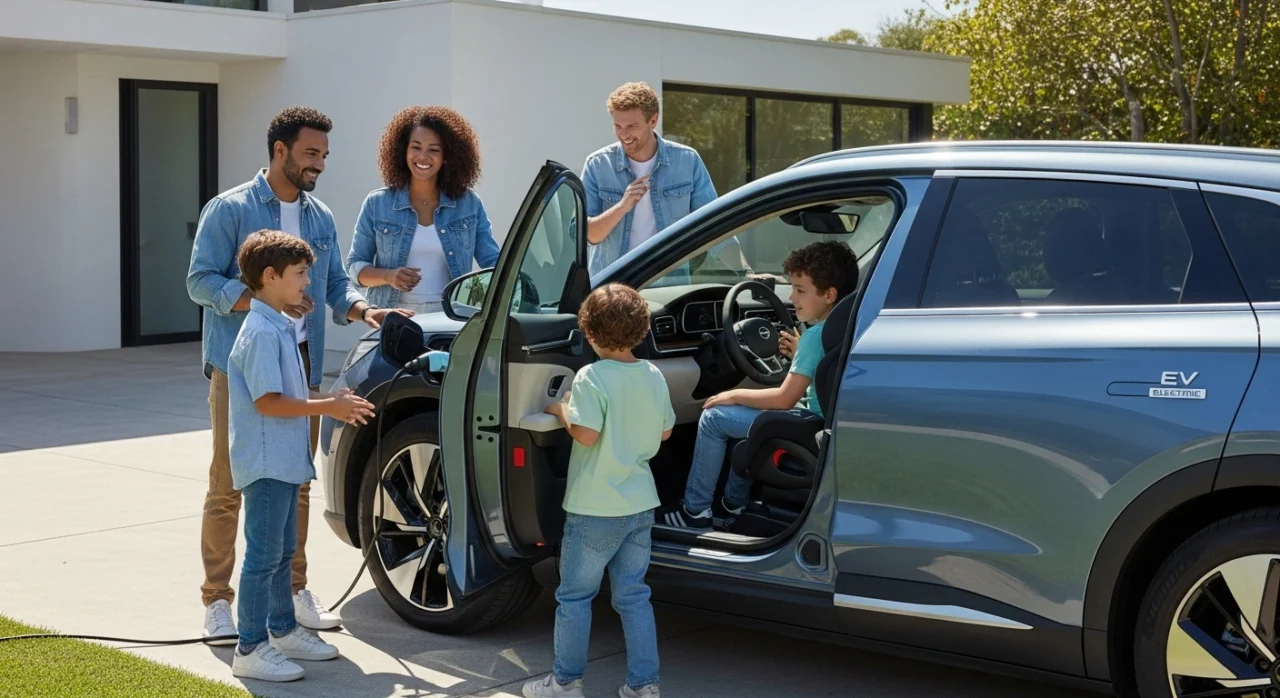
family EV cars with child safety features: Electric vehicles (EVs) are reshaping family transportation. They’re quieter, often cheaper to run, and packed with modern safety tech — which makes them a natural choice for parents. But not all EVs are created equal when it comes to protecting children. This long-form guide walks you through what actually matters: the child-specific safety features you should prioritize, why they matter, how to evaluate cars, and practical tips for daily family life with an EV. No marketing fluff — just straightforward, usable advice.
Why choose an EV for a family?
Before we dive into child safety specifics, it helps to understand the family-friendly advantages EVs bring:
- Lower cabin vibration and noise: A quieter interior means fewer distractions and a calmer environment for kids, especially toddlers and infants who nap in the car.
- Simpler maintenance: Fewer moving parts (no oil changes, fewer belts) can mean fewer surprise breakdowns — beneficial when you’re juggling kids and schedules.
- Instant torque and predictable braking behavior: Electric motors deliver smooth acceleration and regenerative braking that can be tuned to aid driver control.
- Modern active safety tech: Many EVs are built on new platforms and ship with advanced driver assistance systems (ADAS) as standard rather than optional extras.
- Environmental considerations: Lower tailpipe emissions matter to parents thinking long-term about health and air quality.
Those benefits are attractive, but families need features that go beyond adult-centric safety. Let’s dig into the child-focused elements that make some EVs excellent family cars — and some not suitable at all.
Core child safety features every family EV should have
Here’s a prioritized list of child-safety features you should look for when shopping for a family EV. Think of the list as a checklist to bring to test drives and negotiations.
1. ISOFIX / LATCH anchor points and top-tether anchors
These are non-negotiable. ISOFIX (or LATCH in some markets) is the standardized anchoring system for child seats. A car should offer:
- Clearly labeled lower anchors in rear outboard seats.
- A top-tether point for each seating position where possible.
- Enough space between seats so larger child seats don’t interfere with neighboring seats.
2. Rear seat space & geometry
A car can have ISOFIX, but cramped rear seats make installing bulky child seats a nightmare. Look for:
- Flat seat cushions that allow child seats to sit flush.
- Sufficient legroom so front seat occupants can still sit comfortably with a rear-facing seat installed.
- A wide enough center rear seat if you intend to fit three across.
Read Also: BYD ultra-fast charging EV Set to Transform Europe’s Premium Electric Car Market
3. Child safety door locks & windows
Physical child locks on rear doors and windows are essential. Many modern EVs add:
- Electronic child lock that can be controlled from the driver’s console.
- Pinch-detection and auto-reverse on power windows.
4. Rear Occupant/Child Presence Detection
One of the biggest safety advances in recent years is systems that detect a child left in the rear seat and alert the driver (or send notifications). These systems use sensors or software analyzing door opening/closing patterns, seat-belt usage, or cabin movement. For families, this can be life-saving.
5. Rear cross-traffic and blind-spot detection optimized for small targets
Sensors and cameras should reliably detect children and small objects crossing behind or beside the car, especially during low-speed maneuvers in driveways and parking lots.
6. Robust ADAS with low-speed automatic emergency braking (AEB)
Automatic emergency braking that works at low speeds (0–30 km/h) can prevent run-over incidents in parking lots or driveways. The system should also react to pedestrians and cyclists, not just adult-sized targets.
7. Secure seatbelt reminders for all rear seats
Seatbelt reminders and interlock warnings must cover each rear position. Some vehicles now refuse to shift into drive if a front seatbelt is unbuckled; a similar philosophy for rear belts (strong audible/visual warnings) is helpful.
8. Proper airbag configuration and deactivation
Passenger airbags must be deactivatable when a rear-facing infant seat is placed in the front passenger seat (though the best practice is to install infants in the rear). Ensure airbags are not designed in a way that could harm a child in a crash.
9. Interior air quality and HVAC controls
Children are more sensitive to air quality. Features such as cabin air filtration with particulate filters, rear HVAC vents, and independent rear climate controls are important for comfort and health.
10. Battery safety & structural integrity
While rare, battery fires or fuel-system failures are high-consequence events. Family EVs should have:
- A battery pack that’s enclosed and protected by a structural frame.
- Multiple layers of thermal management.
- Well-engineered crash structures that route impact energy away from the battery.
Read Also: EV Battery Fires and Insurance: Causes, Claims & Coverage Explained
How to evaluate child safety features on a test drive
A test drive is where you discover how practical a car is for everyday family life. Here’s what to do and what to look for.
Installation trial
Bring your child seat(s) to the dealership and install them. Watch for:
- Ease of reaching and clipping ISOfix anchors.
- Whether the seat reclines properly.
- Interference with front seatbacks or center consoles.
Access and egress
Have an adult simulate lifting a child in and out of the seat:
- Is the door opening wide enough?
- Does the low roofline or high belt line get in the way?
- Is the threshold height comfortable to lift a child into?
Visibility & cameras
Check the rear view and 360-degree camera views:
- Can you clearly see the rear seat area with interior mirrors and cameras?
- Does the rear camera show obstacles at low height (child-level)?
Controls & alerts
Test the ADAS and cabin alert systems:
- Does the child presence detection or rear occupant alert trigger correctly if someone sits in the back?
- How loud are the seatbelt warnings, and do they stay active long enough to be effective?
Comfort test
Sit in the rear seats yourself for a few minutes:
- Is the ride smooth?
- Are there rear climate vents?
- Is the cabin noise level low enough for children to sleep?
Practical features that matter day-to-day
Beyond crash protection and detection, practical features make family life easier and safer.
Sliding rear doors vs hinged doors
Sliding doors (common in minivans and some compact MPVs) remove the risk of a child opening a door into traffic and are fantastic in tight parking spots.
Low step-in height
A low sill is kinder on backs and reduces the risk of slips when loading kids into booster seats.
Storage & modularity
Large, easily reachable cubbies for wipes, snacks, and toys, plus under-seat storage and seatback organizers, keep the cabin tidy and reduce loose objects during a crash.
Easy-to-clean materials
Spills are inevitable. Leatherette or washable upholstery is more practical than delicate fabrics.
Quiet drive modes and child-friendly ambient lighting
Modes that reduce cabin noise and soft ambient lighting help soothe toddlers during night drives.
Read Also: EV Insurance Claim Rejections: Reasons, Risks & How to Avoid Them
Child seat compatibility: rear-facing, forward-facing, boosters
As kids grow, their seat requirements change. Any family EV should accommodate:
- Rear-facing infant seats (birth to ~2 years): Requires space and proper top-tether or ISOFIX guidance if the seat is convertible.
- Forward-facing seats (2–4 years and up): Look for multiple harness heights and extra recline settings.
- Booster seats (4 years and older): Ensure the vehicle’s belt geometry positions the shoulder belt across the child’s chest, not the neck.
If you plan to use three seats across the rear, verify that the center seat has a proper lap/shoulder belt and a stable installation point.
Safety certifications & ratings
Use independent crash-test results to guide decisions. While specifics vary by market, look for cars with:
- Strong overall crash ratings from a recognized authority.
- Good scores for child occupant protection.
- Positive assessments for whiplash, side impact, and roof strength.
These ratings give a high-level picture of how the vehicle manages impacts that could endanger kids.
Buying guide: checklist before you sign
Print this checklist or save it on your phone and use it at the dealership.
- ISOFIX/LATCH anchors on rear outboard seats? ✔
- Top-tether for each rear position? ✔
- Rear seat width and legroom measured with your child seat(s) fitted? ✔
- Rear occupant/child presence detection present? ✔
- Low-speed AEB with pedestrian detection? ✔
- Rear cross-traffic and blind-spot systems that detect small targets? ✔
- Child locks (manual or electronic) on rear doors and windows? ✔
- Airbag deactivation for front passenger (if you must install child forward-facing in front)? ✔
- Rear HVAC vents and cabin air filter? ✔
- Solid crash-test child occupant protection rating? ✔
If any of these boxes remain unchecked, ask the dealer if the feature is standard or optional — and how much it costs.
Family EV maintenance & ownership tips for safety
Owning an EV has a small learning curve. These habits reduce risk and prolong battery life.
- Keep charging equipment in good condition. Replace frayed cables and use surge protectors where recommended.
- Follow software updates. Automaker updates often include safety patches and battery management improvements.
- Document every service and recall response. Keep records to support future insurance claims.
- Inspect after impacts, however minor. A scruffy underbody or a scrape may indicate battery panel damage.
- Avoid charging immediately after water exposure. Let a professional inspect and dry the vehicle.
- Teach kids EV etiquette: doors, seat belts, and not touching charging ports.
Road-trip safety with kids in an EV
Long trips with children are easier if you plan for charging and comfort.
- Map chargers with family facilities. Pick charging stops with restrooms, play areas, or family rooms.
- Plan shorter legs and more stops. Kids need movement; frequent breaks reduce stress.
- Pack a health & safety kit. Include child-sized first aid basics and a familiar blanket or toy.
- Use car modes that optimize cabin comfort. Pre-condition the cabin while the car is plugged in to preserve range.
- Secure all loose items. A stray bag can become dangerous in sudden stops.
Myths and realities — quick debunk
- Myth: “EV batteries explode like fuel tanks.”
Reality: EV battery incidents are rare and do not behave like petrol explosions. Batteries can burn intensely, but modern packs have protections and are designed to survive impacts. - Myth: “Child seats don’t work well with EVs.”
Reality: Most EVs accommodate modern child seats perfectly when the vehicle has proper ISOFIX anchors and adequate rear room. - Myth: “Charging an EV is dangerous for kids at home.”
Reality: With certified home chargers and proper installation, charging is safe. Keep cables tidy and teach children not to touch equipment.
Final thoughts
Choosing a family EV is more than picking the most efficient battery or flashiest infotainment system. It’s about measurement, fit, and real-world usability. The best family EV is one that combines well-designed crash protection, practical interior space, child-oriented detection systems, and a user-friendly day-to-day experience.
Bring your child seats to the test drive. Install them. Sit in the rear seats. Test the alerts. Ask for full service and software update histories. Those few extra minutes at the dealership can prevent a lifetime of regret.
[…] Read Also: Family EV cars with child safety features […]
[…] Read Also: Family EV cars with child safety features […]
[…] Read Also: Family EV cars with child safety features […]